How Big Is My Slow Cooker
Ever wondered, “How big is my slow cooker?” This comprehensive guide provides simple, step-by-step methods to accurately determine its capacity, from checking labels to precise water measurements. Understanding your slow cooker size is crucial for successful recipes, preventing over or under-cooking, and ensuring efficient meal planning. You’ll learn how to confidently match recipes to your appliance, guaranteeing perfectly cooked dishes every time.
How Big Is My Slow Cooker
Do you ever stare at your slow cooker, wondering, “How big is my slow cooker, really?” You’re not alone! It’s a common question that many home cooks ponder. While some slow cookers clearly state their capacity on the front, others are a bit more mysterious. Guessing the size can lead to all sorts of cooking mishaps, from watery stews to overflowing casseroles.
But don’t worry! This comprehensive guide is here to help you unlock the mystery of your slow cooker’s true capacity. We’ll walk you through easy, step-by-step methods to accurately determine your slow cooker size, whether it’s a brand-new appliance or a beloved hand-me-down. Knowing its exact capacity is fundamental to successful slow cooking, ensuring your meals turn out perfectly every time. By the end of this guide, you’ll be able to confidently choose recipes, adjust ingredients, and cook delicious dishes tailored perfectly to your appliance.
Key Takeaways
- Multiple Methods for Sizing: You can determine your slow cooker’s capacity by checking labels, manuals, or accurately measuring with water.
- Water Measurement is Most Accurate: Filling the stoneware insert with water up to its practical fill line (1-2 inches from the top) and converting cups to quarts or liters provides the most precise capacity.
- Capacity (Quarts/Liters) is Key: The functional size of your slow cooker is measured by its liquid capacity, not just its external dimensions.
- Size Impacts Cooking: Using the correct slow cooker size for a recipe prevents food from being overcooked, undercooked, or drying out, and avoids messy boil-overs.
- Common Sizes for Every Need: Slow cookers typically range from 1.5-quart mini models for individuals to 8-quart giants for large families and entertaining.
- Avoid Overfilling and Underfilling: For best results and food safety, always fill your slow cooker between half and two-thirds full, but never more than three-quarters.
- Match to Your Serving Needs: Choose a slow cooker size that comfortably accommodates the number of servings you typically prepare, considering both everyday meals and special occasions.
Why Your Slow Cooker Size Matters
Understanding your slow cooker’s capacity is more important than you might think. It’s not just about fitting food inside; it directly impacts how your food cooks. Here’s why knowing your exact slow cooker size is crucial for culinary success:
- Prevents Overcooking or Undercooking: A recipe designed for a 6-quart slow cooker will cook differently in a 3-quart or 8-quart model. Too much empty space can cause food to cook too quickly or dry out, while an overfilled slow cooker might not reach safe cooking temperatures or could boil over.
- Ensures Proper Liquid Ratios: The amount of liquid in a slow cooker recipe is balanced for a specific volume. If your slow cooker size is significantly different, you might end up with a watery dish (too much liquid for the space) or a dry, burnt meal (not enough liquid).
- Optimizes Cooking Time: The size of your slow cooker affects how long it takes for the contents to heat up and cook thoroughly. Matching your cooker to the recipe’s intended size helps you stick to recommended cooking times.
- Maintains Food Safety: An underfilled slow cooker can sometimes heat too quickly, potentially skipping the “safe zone” for some foods. An overfilled one might not heat evenly, leaving some parts of the food at unsafe temperatures.
- Avoids Messy Spills: We’ve all been there – a slow cooker filled to the brim that bubbles over, creating a sticky mess on your countertop. Knowing your slow cooker’s practical fill capacity prevents these frustrating incidents.
- Simplifies Recipe Adjustments: Once you know your slow cooker size, you can confidently scale recipes up or down, making it easier to cook for one or for a crowd.
In short, knowing your slow cooker size is the first step towards consistent, delicious, and stress-free slow cooking. Let’s dive into how you can figure it out!
Method 1: Check the Label, Manual, or Bottom of the Crock
This is often the easiest and quickest way to determine your slow cooker size. Many manufacturers clearly label their products.
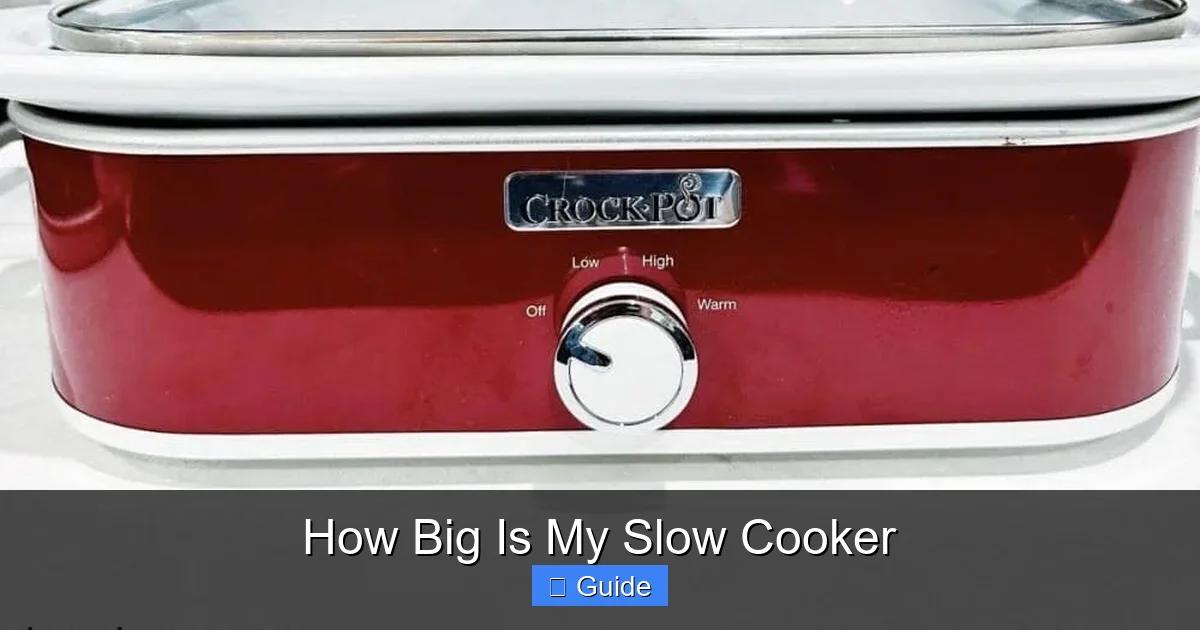
Visual guide about how to identify slow cooker size
Image source: slowcookergourmet.net
Step 1: Look for Labels on the Appliance
Start by carefully examining the exterior of your slow cooker. Many models have a sticker or a printed label on the front, back, or side of the heating base. Look for terms like “Capacity,” “Size,” “Quarts,” or “Liters.” You might see something like “6-Quart Slow Cooker” or “5.7L Crock-Pot.”
Step 2: Check the Underside of the Heating Base
Sometimes, the capacity information is subtly stamped or printed on the bottom of the heating element base. Gently turn your slow cooker over (ensure it’s unplugged and cool!) and look for any identifying marks or serial numbers that might include the size.
Step 3: Consult the User Manual
If you still have the original user manual or packaging, this is a goldmine of information. The slow cooker size, usually listed in quarts or liters, will be prominently featured in the specifications section. If you don’t have the physical manual, try searching online. Most manufacturers provide digital versions of their manuals on their websites. Just search for your slow cooker’s brand and model number (which you can often find on the bottom of the appliance).
Step 4: Examine the Stoneware Insert
Occasionally, the capacity might be molded or printed onto the bottom of the removable stoneware insert itself. Lift out the ceramic crock and check its base. Be aware that sometimes this will list a model number rather than the capacity, but it’s worth a look.
If you find a clear indication, fantastic! You’ve successfully determined your slow cooker size. If not, don’t worry – the next method is foolproof and highly accurate.
Method 2: Step-by-Step Guide to Measuring Your Slow Cooker’s Capacity with Water
This method is the most accurate way to determine your slow cooker size, especially if you can’t find a label, manual, or clear indication. It requires a bit of patience but gives you precise results you can trust.
Visual guide about how to identify slow cooker size
Image source: soyummy.com
What You’ll Need:
- Your slow cooker’s stoneware insert (the ceramic pot)
- A liquid measuring cup (preferably a 2-cup or 4-cup capacity for efficiency)
- A pitcher or a large cup for easier pouring
- Pen and paper (or a calculator) for jotting down measurements
Step 1: Prepare Your Slow Cooker Insert
First, make sure your slow cooker’s stoneware insert is completely empty, clean, and dry. Remove it from the heating base and place it on a flat, stable surface like your kitchen counter or a table. This prevents any accidental spills or inaccuracies.
Step 2: Start Measuring and Pouring
Using your liquid measuring cup, carefully fill it with water up to a distinct measurement line (e.g., 1 cup, 2 cups, or 1 quart). Be precise with your measurements. Pour this water from the measuring cup into the slow cooker insert. Keep a running tally of how much water you’ve added. It’s helpful to write down each amount as you pour it into the stoneware pot.
Example: Pour 2 cups, write down “2 cups.” Pour another 2 cups, write down “4 cups total.”
Step 3: Fill to the “Usable” Capacity
Continue pouring water into the insert, taking note of each measurement. This is a critical step: stop filling when the water reaches about 1 to 2 inches (2.5 to 5 cm) from the very top rim of the stoneware insert.
Why is this important? You never want to fill a slow cooker completely to the brim when cooking. It needs headspace for steam to circulate, to prevent liquids from boiling over, and to allow for expansion of ingredients. This “usable” capacity is the true, practical slow cooker size you’ll be working with for recipes. Filling it past this point can lead to a messy kitchen and potentially uneven cooking.
Step 4: Total Your Measurement
Add up all the amounts of water you poured into the slow cooker. For example, if you poured 2 cups five times, and then 1 cup, your total measurement would be 11 cups.
Step 5: Convert to Quarts or Liters
Slow cooker capacities are almost always given in quarts (for U.S. and some international markets) or liters (for metric regions). Here’s how to convert your total cup measurement:
- To Convert to Quarts: There are 4 cups in 1 quart. Divide your total cup measurement by 4.
- Example: 11 cups / 4 = 2.75 quarts.
- To Convert to Liters: There are approximately 4.23 cups in 1 liter. Divide your total cup measurement by 4.23.
- Example: 11 cups / 4.23 ≈ 2.6 liters.
Once you have your calculated capacity, round it to the nearest common slow cooker size. For instance, 2.75 quarts would typically mean you have a 3-quart slow cooker. 5.5 quarts would be a 6-quart model. Don’t stress over tiny fractions; manufacturers generally round to convenient whole or half-quart numbers.
Tips for Accurate Water Measurement:
- Use a reliable measuring cup: Ensure your liquid measuring cup has clear, accurate markings.
- Measure slowly and carefully: Spills can skew your results and make a mess.
- Take notes as you go: Don’t try to remember everything in your head; jot down each pour.
- Identify the practical fill line: Always remember to stop filling 1-2 inches from the top to find the true usable capacity. This represents the practical slow cooker size for cooking.
- Double-check if unsure: If you’re unsure about your measurement, empty the pot and repeat the process. Practice makes perfect!
Method 3: Estimate by Dimensions (Less Precise)
While not as accurate as the water measurement, understanding the general physical dimensions of your slow cooker can give you a rough idea of its size, especially when comparing models or making quick estimates.
Visual guide about how to identify slow cooker size
Image source: images.squarespace-cdn.com
Step 1: Measure Key Dimensions
Grab a measuring tape and note down the following for your stoneware insert (the removable pot):
- Height: Measure from the bottom of the insert to about 1-2 inches from the top rim (to account for the practical fill line).
- Diameter (for round slow cookers): Measure across the widest point of the top opening.
- Length and Width (for oval slow cookers): Measure the longest side and the widest side of the top opening.
Step 2: Compare to Common Sizes
Armed with your dimensions, you can cross-reference them with typical measurements of common slow cooker sizes. Here are some approximate internal dimensions for the stoneware insert (these can vary by brand, so use them as a general guide):
- 1.5 to 2 Quarts: Roughly 5-6 inches in diameter, 4-5 inches high.
- 3 to 4 Quarts: Roughly 7-8 inches in diameter (round) or 8-9 inches long (oval), 5-6 inches high.
- 5 to 6 Quarts: Roughly 9-10 inches in diameter (round) or 10-12 inches long (oval), 6-7 inches high.
- 7 to 8 Quarts: Roughly 10-11 inches in diameter (round) or 13-15 inches long (oval), 7-8 inches high.
Remember, this method provides an estimate. The internal volume of the pot, considering its tapering shape, is what truly determines the slow cooker size. This method is best used as a quick visual check or when you have no other means of measurement.
Understanding Common Slow Cooker Sizes and Shapes
Now that you know how to measure, let’s look at what those numbers actually mean in the world of slow cooking. Slow cookers come in a variety of sizes and shapes, each suited for different cooking needs.
Common Slow Cooker Sizes:
- 1.5 to 2 Quarts (1.4-1.9 Liters): These are mini or “lunch-sized” slow cookers, perfect for cooking for one or two people, heating dips, small side dishes, or keeping sauces warm.
- 3 to 4 Quarts (2.8-3.8 Liters): Ideal for 2-3 people. Great for smaller roasts, soups, stews, or chili for a modest family meal.
- 5 to 6 Quarts (4.7-5.7 Liters): This is the most popular and versatile slow cooker size. It’s perfect for families of 4-6 people. It can accommodate a whole chicken, a large roast, or a significant batch of soup or chili, making it suitable for most standard recipes.
- 7 to 8 Quarts (6.6-7.6 Liters): These large slow cookers are designed for big families (6+ people), entertaining, potlucks, or meal prepping large quantities. They can easily fit bigger cuts of meat like a turkey breast or a beef roast for a crowd.
- 10+ Quarts (9.5+ Liters): Extra-large models are available for serious batch cooking, very large gatherings, or specialty catering.
Slow Cooker Shapes:
- Round: Traditional and often smaller slow cookers are round. They are great for soups, stews, casseroles, and dishes without awkward shapes.
- Oval: More common in medium to larger sizes, oval slow cookers are excellent for cooking larger cuts of meat like whole chickens, roasts, or ribs, as they better accommodate irregular shapes. Most slow cooker recipes are developed with an oval shape in mind.
- Rectangular: Less common, but some very large or specialty slow cookers come in rectangular shapes, offering maximum space for items like lasagna or multiple dishes.
Understanding both the capacity and shape of your slow cooker will help you choose recipes that fit perfectly and cook optimally.
Practical Tips for Using the Right Slow Cooker Size
Knowing your slow cooker size is just the beginning. Here are some practical tips to ensure you use it effectively for every meal:
1. Match Your Slow Cooker to Your Recipe
Always check the recommended slow cooker size in a recipe. If a recipe calls for a 6-quart cooker and you only have a 3-quart, you’ll need to halve the ingredients. Conversely, if you’re using an 8-quart slow cooker for a 4-quart recipe, the food might cook faster or dry out. Consider scaling the recipe up to fit a larger pot or adding extra vegetables or broth to fill the space.
2. The “Half to Two-Thirds Full” Rule
For optimal cooking and safety, your slow cooker should generally be filled between half and two-thirds full. Never fill it more than three-quarters full. This allows enough space for proper heat circulation, prevents boil-overs, and ensures food cooks evenly and safely.
- Underfilling: If your slow cooker is less than half full, the food can cook too quickly and potentially dry out or burn. The smaller amount of food also may not heat evenly, depending on the cooker. If you must cook a small amount in a large slow cooker, consider using a smaller heat-safe container (like an oven-safe bowl) placed inside the larger slow cooker, surrounded by a little water for indirect heat.
- Overfilling: Filling past the three-quarters mark risks overflowing as the food expands and liquid generates steam. It also means the food may not reach a safe temperature evenly or quickly enough, posing a food safety risk.
3. Adjust Liquids Wisely
Slow cookers retain moisture very efficiently because of their tight-fitting lids. For most recipes, you’ll need less liquid than you would for stovetop or oven cooking. If you’re adapting a conventional recipe to your slow cooker, reduce the liquid by about one-third to one-half, especially if it contains watery ingredients like vegetables or meat that will release their own juices. However, if your slow cooker size is significantly smaller than the recipe’s intention, you might need to adjust liquid even further down.
4. Consider Cooking Time Adjustments
While recipes often provide a time range (e.g., 4-6 hours on high), your specific slow cooker size and how full it is can affect this. A larger, fuller slow cooker might take slightly longer to heat up and cook through compared to a smaller, less full one, or vice-versa if the large cooker has too much empty space causing it to overheat. Always use a meat thermometer to ensure meats are cooked to a safe internal temperature.
5. Think About Your Serving Needs
When buying a new slow cooker, consider your household size and cooking habits.
- 1-2 people: 1.5-3 quart slow cooker.
- 3-4 people: 4-5 quart slow cooker.
- 4-6 people: 6-7 quart slow cooker.
- 6+ people or entertaining: 7-8+ quart slow cooker.
If you love to entertain or make large batches for meal prepping, a larger slow cooker size is a smart investment, even if you don’t use its full capacity every day.
Troubleshooting Common Slow Cooker Size Issues
Even after knowing your slow cooker size, you might encounter a few quirks. Here’s how to troubleshoot common issues:
Issue 1: My food is drying out or burning.
Possible Causes & Solutions:
- Slow cooker is too large for the recipe: If your slow cooker is significantly underfilled, the ingredients can cook too quickly and dry out or burn around the edges. Try scaling up the recipe, adding extra non-starchy vegetables, or placing a smaller, oven-safe bowl inside your larger slow cooker (with a little water in the larger pot) to create a “double boiler” effect.
- Not enough liquid: Always ensure there’s enough liquid to cover at least half of the ingredients in your slow cooker. For recipes adapted from traditional cooking, remember to reduce the liquid slightly, but don’t eliminate it entirely.
- Lid lifted too often: Every time you lift the lid, a significant amount of heat and moisture escapes, adding 20-30 minutes to the cooking time. Resist the urge to peek!
Issue 2: My food is watery or taking too long to cook.
Possible Causes & Solutions:
- Slow cooker is too small or overfilled: If your slow cooker is packed too tightly, it might not reach temperature effectively or could release too much moisture that has nowhere to evaporate. Ensure you adhere to the “half to two-thirds full” rule.
- Too much liquid: Slow cookers are incredibly efficient at retaining moisture. If your recipe is too soupy, reduce the liquid next time. You can often thicken watery sauces by removing the lid for the last 30 minutes of cooking, or by stirring in a cornstarch slurry (1 tbsp cornstarch mixed with 1 tbsp cold water) during the last hour.
- Lid isn’t sealing properly: Check your lid for any chips or cracks. A loose-fitting lid lets too much heat and steam escape, leading to longer cooking times and less effective cooking. Some slow cookers have locking lids, ensure they are properly secured if applicable.
Issue 3: I can’t find any size information on my slow cooker.
Solution: This is precisely why we included Method 2! The water measurement method is the most reliable way to find your slow cooker size when no labels or manuals are present. Take your time, measure carefully, and you’ll get an accurate result.
Conclusion
Knowing the answer to “How big is my slow cooker?” is a foundational skill for any slow cooking enthusiast. It empowers you to choose the right recipes, adjust ingredients with confidence, and avoid common cooking pitfalls. Whether you’ve checked a label, consulted a manual, or meticulously measured with water, you now possess the knowledge to accurately determine your appliance’s capacity.
No more guessing games! With your newfound understanding of slow cooker size, you’re set to create perfectly cooked, delicious meals every time. So go ahead, dust off that crock pot, pick a recipe that perfectly fits its dimensions, and enjoy the effortless magic of slow cooking!
Jennifer D. Simon has spent the last 26 years studying and practicing nutrition science. She has used a larger part of this time in improving people’s livelihoods. She has done so by coming up with unquestionable ideas on how to tackle food problems in her community. Read More